How to Correct VAT Errors on a VAT Return: HMRC Rules for 2026
VAT
Published: 8/13/2026
Made a mistake on a UK VAT Return? The correct way to fix it depends on the net value of the error, whether it was deliberate, and when it occurred. Smaller VAT errors can often be corrected on a later VAT Return, while larger or deliberate errors normally need to be reported separately to HMRC. This guide explains the current VAT error correction rules, thresholds, time limits and practical steps for UK businesses.
VAT mistakes are not unusual. A sales invoice might have been entered twice, input VAT may have been claimed incorrectly, the wrong VAT rate may have been applied, or a transaction might have been included in the wrong VAT period.
What matters is identifying the error promptly, calculating its overall effect accurately and using the correct HMRC correction method. Simply changing a figure without correcting the underlying accounting records can leave a VAT control account that no longer reconciles with submitted returns.
How Do You Correct VAT Errors on a VAT Return?
HMRC broadly provides two ways of correcting errors discovered after a VAT Return has been submitted: adjusting a later VAT Return or notifying HMRC separately.
Which method applies depends primarily on the net value of the VAT error. This means businesses should identify all relevant VAT overstatements and understatements and calculate their combined effect rather than considering each mistake independently.
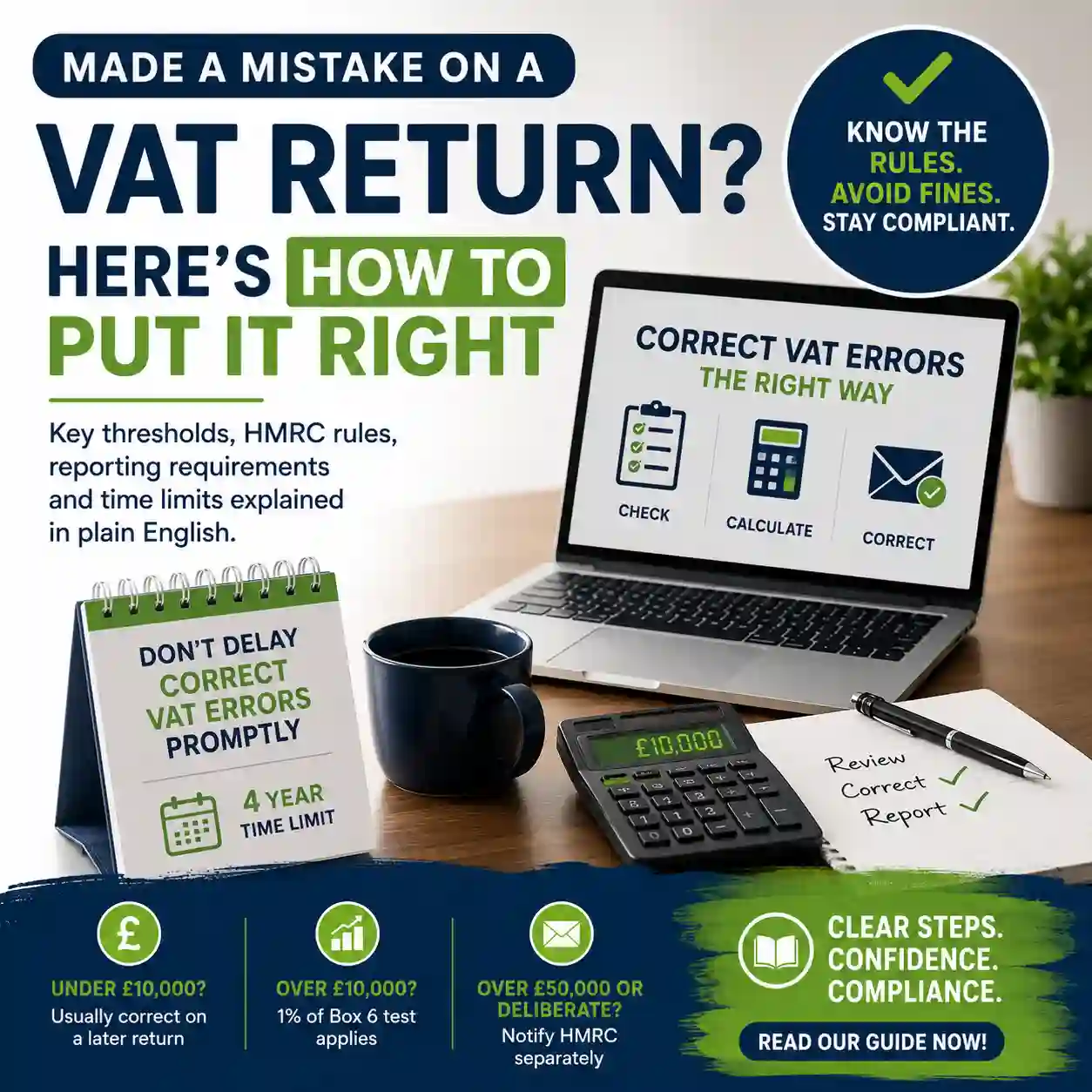
| Net VAT error | Typical correction method | Important consideration |
|---|---|---|
| £10,000 or less | Usually correct on a later VAT Return | The error must not be deliberate. |
| More than £10,000 but no more than £50,000 | May be corrected on a later VAT Return if it does not exceed 1% of the Box 6 figure | If the error exceeds the 1% test, HMRC should normally be notified separately. |
| More than £50,000 | Notify HMRC separately | The correction should not simply be included in a subsequent VAT Return. |
| Deliberate error of any value | Notify HMRC separately | Deliberate inaccuracies have separate disclosure and penalty considerations. |
Step 1: Calculate the Net VAT Error
Start by reviewing the affected VAT period and identifying every error that needs correcting. Separate errors that caused VAT payable to HMRC to be understated from those that caused it to be overstated, then calculate the overall net effect.
For example, suppose one mistake caused VAT payable to be understated by £7,000 while another error in the same correction calculation caused VAT payable to be overstated by £2,000. The resulting net error would be £5,000.
Keep clear evidence showing:
- What the original VAT treatment was.
- Why the original treatment was incorrect.
- The VAT periods affected.
- The calculation used to determine the correction.
- Any bookkeeping entries or journals used to correct the accounting records.
- How and when the correction was reported to HMRC.
Step 2: Decide How the VAT Error Must Be Corrected
Correcting Smaller Errors on a Later VAT Return
Where a VAT error falls within HMRC's permitted limits, it can normally be adjusted through a later VAT Return.
If the correction means additional VAT is payable to HMRC, the net adjustment will generally affect Box 1 of the later return. If the correction means additional VAT can be reclaimed, it will generally affect Box 4.
The corresponding accounting records should also be corrected so that the VAT control account, bookkeeping records and submitted return remain consistent.
Reporting Larger VAT Errors Separately to HMRC
Separate notification is normally required where the net VAT error exceeds the adjustment limits, where an error between £10,000 and £50,000 fails the 1% of Box 6 test, or where the error was deliberate.
HMRC provides an online process for notifying VAT Return errors. Businesses should use HMRC's current correction procedure rather than relying on historic guidance or old forms that may no longer apply to ordinary VAT Return corrections.
What If You Find the VAT Error Before Filing the Return?
If you identify the mistake before the VAT Return has been submitted, correct the underlying accounting records first and prepare the VAT Return from the corrected figures.
The post-submission VAT error rules are primarily relevant where a mistake is discovered after the affected return has already been sent to HMRC.
A good pre-submission VAT review should normally include reconciliations between:
- Sales records and VAT outputs.
- Purchase records and input VAT claims.
- The VAT control account and VAT Return.
- Bank transactions and accounting records where appropriate.
- VAT scheme calculations where the business uses a special accounting scheme.
How Far Back Can You Correct VAT Errors?
The normal VAT error correction time limit is four years, although the exact point from which the four-year period is calculated can depend on the type of error involved.
Businesses that discover historic discrepancies should therefore investigate them promptly. Leaving an error unresolved can result in a valid correction or repayment claim falling outside the applicable time limit.
Historic VAT reviews can be particularly useful following:
- A change of accountant or bookkeeper.
- A migration to new accounting software.
- The acquisition or disposal of part of a business.
- A change in VAT accounting scheme.
- The discovery of recurring transaction coding errors.
- An HMRC compliance enquiry or VAT review.
Can Correcting a VAT Error Result in an HMRC Penalty?
Correcting a VAT mistake does not automatically mean that HMRC will charge a penalty.
HMRC can consider factors such as how the error arose, whether the business took reasonable care, whether the inaccuracy was careless or deliberate and how the problem was disclosed once it was identified.
Where an error resulted in VAT being paid later than it should have been, interest may also need to be considered.
Businesses should be particularly careful where an error may be regarded as deliberate or where several VAT periods are affected. In these circumstances, the disclosure itself can be as important as the accounting adjustment.
Common VAT Return Errors
VAT mistakes can arise from both bookkeeping errors and incorrect tax treatment. Common examples include:
- Sales invoices omitted from VAT records.
- Sales invoices entered more than once.
- Purchase invoices duplicated.
- Input VAT reclaimed twice.
- Input VAT claimed without appropriate supporting evidence.
- Using the wrong VAT rate.
- Incorrectly treating a transaction as exempt, zero-rated or outside the scope of VAT.
- Using the wrong tax point and reporting VAT in the wrong period.
- Failing to process credit notes correctly.
- Incorrect treatment of refunds.
- Manual journals posted to the wrong VAT code.
- Errors introduced during an accounting software migration.
- Incorrect treatment when entering or leaving a VAT accounting scheme.
Correcting VAT Errors Under Making Tax Digital
Businesses within Making Tax Digital for VAT should ensure that their digital accounting records reflect the correction made to the VAT position.
Where an error was caused by an incorrectly coded invoice or transaction, the underlying accounting entry should normally be corrected where appropriate rather than relying solely on an unexplained manual adjustment to the VAT Return.
Maintaining a clear digital audit trail helps demonstrate:
- The original transaction.
- The reason the VAT treatment was incorrect.
- The correcting accounting entry.
- The VAT Return on which the adjustment was ultimately reflected.
Accusolve provides bookkeeping services for businesses that need help reconciling VAT records and maintaining accurate digital accounting information.
VAT Error Correction Checklist
- Identify every VAT mistake affecting the relevant period.
- Calculate the overall net VAT error.
- Determine whether the error is £10,000 or less.
- For errors between £10,000 and £50,000, apply the 1% of Box 6 test.
- Identify whether any part of the error could be deliberate.
- Check that the correction is within the relevant time limit.
- Correct the underlying accounting and bookkeeping records.
- Reconcile the VAT control account after making the correction.
- Retain calculations and supporting evidence.
- Use the appropriate VAT Return adjustment or separate HMRC notification process.
- Consider professional advice where several periods or significant amounts are involved.
When Should You Ask an Accountant to Correct a VAT Error?
A simple, low-value bookkeeping error may be straightforward to resolve internally. Professional assistance can become more valuable where the position is less clear.
Consider obtaining help where:
- Several VAT periods are affected.
- The total error is close to or above HMRC's reporting thresholds.
- Accounting records do not reconcile with previous VAT Returns.
- The business has incorrectly applied a VAT exemption or VAT rate.
- Historic transactions need to be reconstructed.
- A VAT scheme has been applied incorrectly.
- There may be interest or penalty exposure.
- HMRC has already contacted the business about its VAT affairs.
An accountant can help reconcile the records, calculate the net adjustment, identify the appropriate HMRC correction route and ensure the underlying bookkeeping is corrected at the same time.
Accusolve provides VAT return services alongside wider accounting services. If your VAT issue relates to joining the VAT system, you can also review our VAT registration service.
Need Help Correcting a VAT Return Error?
If you have discovered an incorrect VAT Return, Accusolve can help review the accounting records, calculate the correction and determine the appropriate way to report it to HMRC.
Contact Accusolve AccountantsOfficial HMRC and GOV.UK Sources
FAQs: Correcting VAT Return Errors
You do not normally reopen and overwrite a previously submitted VAT Return.
Depending on the value and nature of the error, you either correct it through a
later VAT Return or notify HMRC separately using HMRC's current VAT error
correction process.
Net VAT errors of £10,000 or less can generally be corrected on a later VAT
Return. Where the error is more than £10,000 but no more than £50,000, that
method can normally only be used where the error does not exceed 1% of the Box 6
figure on the return through which the correction is being made. Deliberate
errors are treated separately.
HMRC changed its general VAT Return error correction process in September 2025.
Businesses should follow HMRC's current online or written notification process
where a separate disclosure is required rather than relying on outdated
instructions for ordinary VAT Return errors.
The normal VAT error correction time limit is four years, although exactly when
that period starts depends on the type of correction involved. Historic errors
should therefore be investigated promptly.
Not necessarily. Penalty treatment depends on the circumstances, including
whether reasonable care was taken, whether the mistake was careless or
deliberate and how the business disclosed and corrected the error. Interest may
also be relevant where VAT was paid late.
Review all affected periods and calculate the total correction carefully.
Repeated errors can indicate an underlying bookkeeping, VAT coding or tax
treatment problem that should be fixed before future VAT Returns are filed.
Professional assistance can be useful where several periods are involved.
Related Guides
Latest Posts





Speak to a UK Accounting Expert Today
From bookkeeping and payroll to management accounts and financial forecasting, Accusolve Accountants helps UK and overseas businesses stay compliant with HMRC and grow with confidence. Get tailored advice from our friendly team.
Get started today
Fast response • Fixed-fee quotes