VAT Flat Rate Scheme UK
VAT
Published: 7/10/2026
The VAT Flat Rate Scheme can make VAT reporting simpler for some UK small businesses, but it is not always the cheapest option. This guide explains who can use the scheme, how limited cost trader rules work, what to check before applying, and when to ask an accountant to compare the numbers properly.
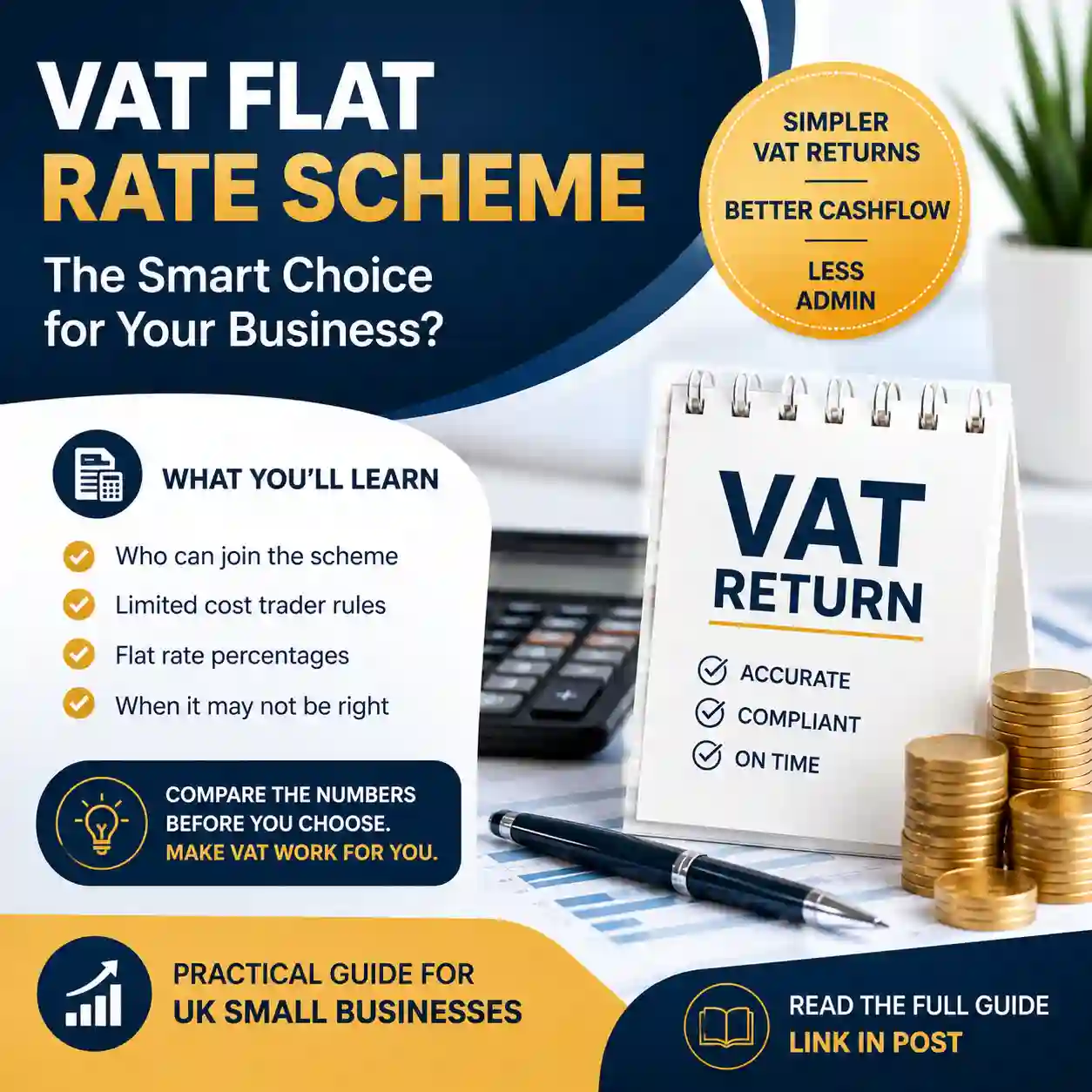
VAT can become complicated quickly for small businesses, especially when turnover is approaching the registration threshold or when a newly registered company needs to choose the most practical way to complete VAT returns. The Flat Rate Scheme is often marketed as a simpler option, but it should not be selected without checking the real numbers.
Under the Flat Rate Scheme, a VAT-registered business applies a fixed percentage to its VAT-inclusive turnover instead of calculating VAT by deducting input VAT from output VAT in the usual way. This can reduce administration and make cashflow easier to forecast. However, because input VAT is generally not reclaimed under the scheme, it may cost more for businesses with meaningful VATable costs.
For consultants, contractors, agencies, small service businesses, ecommerce sellers and startups, the key question is not simply “Can I join?” It is “Will this scheme actually improve my VAT position once my costs, sector rate, limited cost trader status and growth plans are considered?”
What is the VAT Flat Rate Scheme?
The VAT Flat Rate Scheme is a simplified VAT accounting method for eligible small businesses. Instead of calculating VAT due by offsetting VAT charged to customers against VAT paid on purchases, the business pays HMRC a fixed percentage of its gross turnover.
The flat rate percentage depends on the type of business, unless the limited cost trader rules apply. The business still charges VAT to customers in the normal way, but the VAT calculation for the return is simplified.
Who is the Flat Rate Scheme designed for?
The scheme is mainly aimed at smaller VAT-registered businesses that want simpler record keeping and more predictable VAT payments. It can work well for businesses with relatively low VATable expenses, but it can be less suitable where the business regularly buys stock, equipment, subcontracted services or other costs with recoverable VAT.
- Consultants and professional service providers with low VATable costs.
- Contractors who want simpler VAT calculations.
- Startups that have recently completed VAT registration.
- Small businesses that want clearer VAT cashflow planning.
- Directors who want an accountant to compare Flat Rate Scheme VAT against standard VAT accounting.
VAT Flat Rate Scheme eligibility
A business can usually apply to join the Flat Rate Scheme if it is eligible to be VAT registered and expects taxable turnover, excluding VAT, to be no more than £150,000 in the next year. The business must also meet the scheme conditions and avoid exclusions such as certain VAT group, margin scheme, dishonesty penalty or associated business situations.
This is separate from the general VAT registration threshold. A business may need to register for VAT when taxable turnover exceeds the current registration threshold, but whether it should use the Flat Rate Scheme after registration requires a separate calculation.
How the Flat Rate Scheme calculation works
The basic calculation is:
VAT-inclusive turnover × flat rate percentage = VAT payable to HMRC
For example, if a business has VAT-inclusive turnover of £12,000 for the quarter and uses a flat rate percentage of 14.5%, the VAT due under the scheme would be £1,740. This is a simplified example only. The correct sector rate, limited cost trader status and any changes during the VAT period must be checked before relying on a calculation.
The limited cost trader rule
The limited cost trader rule is one of the most important Flat Rate Scheme checks. If a business has low spending on relevant goods, it may need to use a 16.5% flat rate regardless of its normal business sector.
This can significantly reduce, or remove, the financial benefit of using the scheme. Many service-based businesses, consultants and contractors have low relevant goods because software, rent, accountancy fees, subcontractors, advertising and many other costs are services rather than goods for this test.
Before joining or continuing with the Flat Rate Scheme, a business should review whether it is a limited cost trader for each VAT period. A company may fall into the limited cost rate in one quarter and use a sector rate in another if its relevant goods position changes.
The first-year 1% reduction
New VAT registrations may be able to reduce their flat rate percentage by 1% during the first year of VAT registration. This can make the scheme more attractive in year one, but it should not be the only reason for joining.
The reduction is linked to the first year of VAT registration, not simply the date the business joins the Flat Rate Scheme. If VAT registration was late, or if the business joins the scheme after the first year has passed, the discount may not be available.
When the Flat Rate Scheme may be useful
- You have low VATable costs and want simpler VAT reporting.
- You sell mainly to VAT-registered customers who can reclaim VAT.
- You want predictable VAT payments for cashflow planning.
- Your sector rate produces a better result than standard VAT accounting.
- You are in your first year of VAT registration and qualify for the temporary 1% reduction.
- Your records are accurate enough to support turnover, sector and limited cost trader checks.
When the Flat Rate Scheme may be the wrong choice
- You buy stock, equipment or materials with significant input VAT.
- You are a limited cost trader and must use the 16.5% rate.
- You normally receive VAT repayments from HMRC.
- You import goods, sell second-hand goods, use margin schemes or have more complex VAT activity.
- You make construction supplies affected by the domestic reverse charge.
- Your business is growing quickly and may exceed the leaving thresholds.
Flat Rate Scheme and VAT returns
The Flat Rate Scheme does not remove the need to submit VAT returns. Businesses must still keep records, calculate the correct turnover, use the right rate and submit returns on time. The difference is in the way the VAT due is calculated.
For many small businesses, the real value of the scheme is administrative simplicity. However, if bookkeeping is weak, the business may still make mistakes with turnover, rate selection, limited cost trader testing or VAT return boxes. That is why regular bookkeeping and accurate VAT returns remain important.
How to decide whether the Flat Rate Scheme is worth it
The safest approach is to compare both methods before applying:
- Estimate VAT due under standard VAT accounting.
- Estimate VAT due under the relevant flat rate percentage.
- Check whether the limited cost trader rate applies.
- Consider whether the first-year 1% discount is available.
- Review whether future costs, equipment purchases or growth plans will change the result.
- Confirm whether the business is likely to remain within the scheme limits.
This comparison should be revisited as the business grows. A scheme that works in year one may become expensive later if the company hires staff, buys equipment, changes sector, increases stock purchases or moves into more complex VAT activity.
Flat Rate Scheme for London startups and small businesses
London businesses often face higher overheads, faster growth targets and more complex customer profiles. A startup that begins as a simple consultancy may later add software subscriptions, overseas suppliers, subcontractors, ecommerce sales or multi-channel income. These changes can affect VAT treatment and whether the Flat Rate Scheme remains appropriate.
For growth-focused companies, VAT scheme selection should sit alongside wider accounting services, cash flow forecasting, management accounts and accounting software setup. The aim is not just to file a return, but to make sure VAT does not become a cashflow surprise.
How Accusolve Accountants can help
Accusolve Accountants supports UK small businesses, startups, ecommerce businesses, directors and non-UK resident business owners with practical VAT and accounting guidance. We are AAT AML supervised and provide commercially focused support without claiming to be chartered accountants.
We can help you:
- Compare standard VAT accounting against the Flat Rate Scheme.
- Check VAT registration timing and scheme eligibility.
- Review limited cost trader status before VAT returns are submitted.
- Set up bookkeeping processes for accurate VAT records.
- Prepare and file VAT returns.
- Review VAT risks for ecommerce, consultants, contractors and growing companies.
If you are unsure whether the Flat Rate Scheme is right for your business, a short VAT review can help you avoid choosing a scheme that looks simple but costs more in practice.
Citations and source notes
- GOV.UK: VAT Flat Rate Scheme overview — used to confirm the fixed-rate calculation, purchase VAT restrictions, capital asset exception and £150,000 joining reference.
- HMRC VAT Notice 733: Flat Rate Scheme for small businesses — used to confirm scheme purpose, eligibility, benefits, limited cost trader rules, application routes and record keeping considerations.
- GOV.UK: Register for VAT — used to confirm the current VAT registration threshold and registration timing rules.
FAQs: VAT Flat Rate Scheme UK
The VAT Flat Rate Scheme is a simplified VAT accounting method where an eligible business pays HMRC a fixed percentage of VAT-inclusive turnover. It can reduce administration, but it may not always reduce the amount of VAT payable.
A business may be able to join if it is VAT registered or eligible to be VAT registered, expects taxable turnover excluding VAT to be £150,000 or less in the next year, and meets the scheme conditions. Some businesses are excluded, so eligibility should be checked before applying.
A limited cost trader is a business with low spending on relevant goods. If the rule applies, the business normally uses a 16.5% flat rate regardless of its usual sector. This can make the Flat Rate Scheme less attractive for service businesses with few goods purchases.
In most cases, businesses using the Flat Rate Scheme cannot reclaim VAT on purchases. There is an exception for certain capital expenditure goods costing £2,000 or more including VAT, subject to the scheme rules.
Yes, it is sensible to ask an accountant to compare standard VAT accounting with the Flat Rate Scheme before joining. The right choice depends on turnover, sector rate, limited cost trader status, VATable costs and future growth plans.
Related Guides
Latest Posts


Speak to a UK Accounting Expert Today
From bookkeeping and payroll to management accounts and financial forecasting, Accusolve Accountants helps UK and overseas businesses stay compliant with HMRC and grow with confidence. Get tailored advice from our friendly team.
Get started today
Fast response • Fixed-fee quotes