CT600 After 31 March 2026
Corporation Tax & Company Compliance
Published: 4/21/2026
The old HMRC and Companies House joint online filing service closed on 31 March 2026. If your UK company still needs to file a CT600 tax return, you now need a compliant post-closure filing process that usually involves commercial software for HMRC submissions, together with the correct Companies House accounts route for your account type.
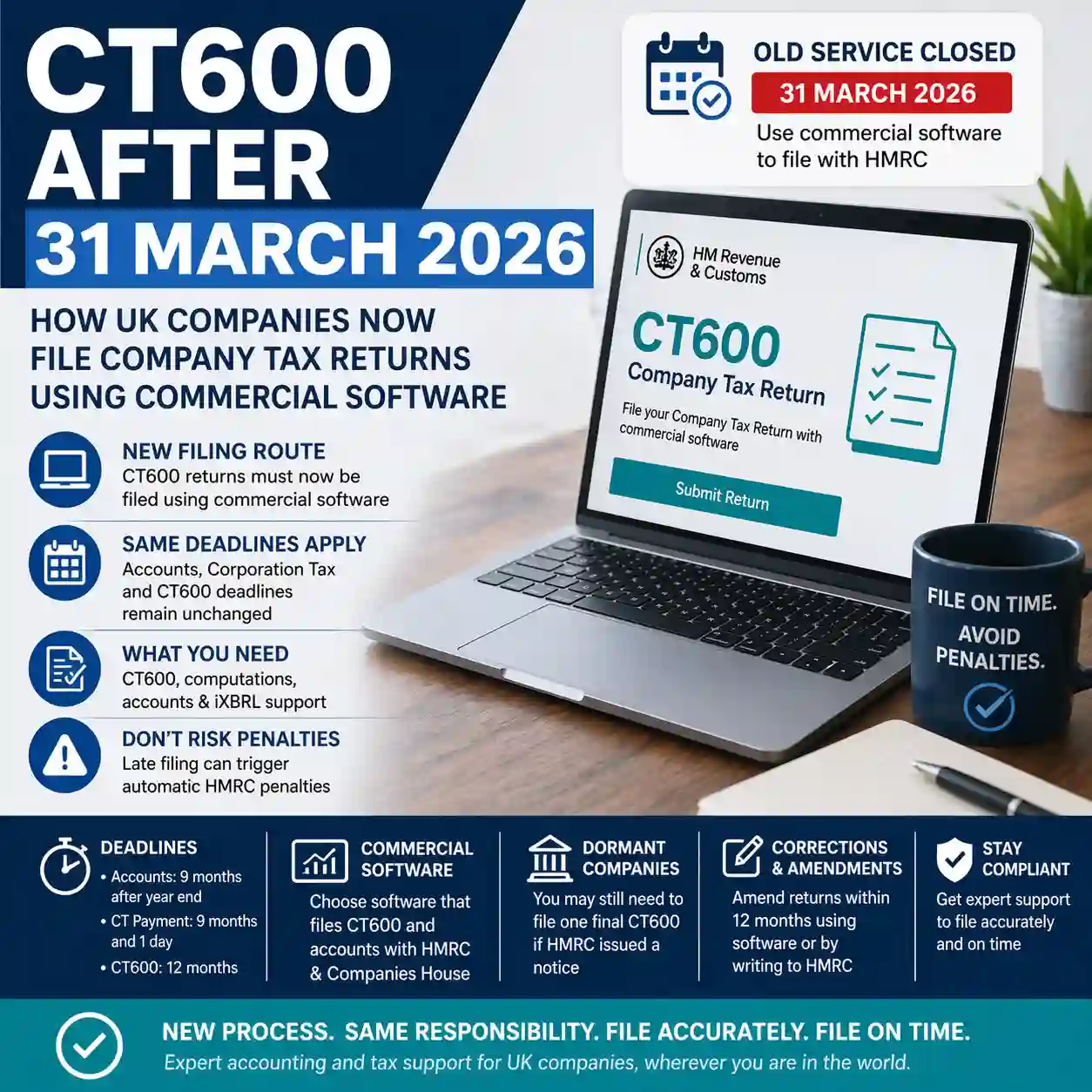
If you run a UK company, the old joint HMRC and Companies House online filing service is no longer available. From 1 April 2026, the practical change is that a company normally needs a new process for its CT600 tax return, while still dealing properly with Corporation Tax, year-end accounts, annual accounts filing, and wider company compliance. The legal deadlines themselves have not changed, but the filing workflow has.
What changed on 31 March 2026
The old government service called “File your accounts and Company Tax Return” closed on 31 March 2026. Since 1 April 2026, companies generally need commercial software to file Company Tax Returns with HMRC unless a specific paper-filing exception applies. Companies House accounts filing still continues, but the correct route depends on the type of accounts you are filing. In some cases the current routes still include software, WebFiling, Find and Update company information, or paper filing by post.
| Position | Before 1 April 2026 | From 1 April 2026 |
|---|---|---|
| Joint HMRC and Companies House online service | Available | Closed |
| CT600 filing with HMRC | Could be done through the joint service | Usually done using commercial software, unless a paper exception applies |
| Companies House accounts filing | Could be done through the joint service for eligible filings | Use the currently available Companies House route for the account type, which may include software, WebFiling, Find and Update, or paper |
| Access to historical filings stored in the old service | Available through that service | No longer available through that service |
What has not changed
The service closure did not change the company’s core legal obligations. A private company still normally files annual accounts with Companies House 9 months after the financial year end, pays Corporation Tax 9 months and 1 day after the Corporation Tax accounting period ends, and files its Company Tax Return 12 months after that accounting period ends. First accounts and unusual year-end situations can still change the detail, but the closure itself did not change those standard rules.
| Action | Usual deadline |
|---|---|
| File first accounts with Companies House | 21 months after incorporation |
| File annual accounts with Companies House | 9 months after the financial year end |
| Pay Corporation Tax or tell HMRC none is due | 9 months and 1 day after the Corporation Tax accounting period ends |
| File the CT600 / Company Tax Return | 12 months after the Corporation Tax accounting period ends |
What your software needs to cover
For HMRC filing, the critical point is not just submitting a CT600 form. The software normally needs to support the wider filing package, including the return itself, the Corporation Tax computation, and the accounts package used with the return. Some software can also support Companies House filing, which can simplify the workflow, but not every company needs the same feature set.
| Feature | Why it matters |
|---|---|
| CT600 submission | Core Company Tax Return filing with HMRC |
| Corporation Tax computation | Supports the figures in the return |
| iXBRL accounts and computations | Usually needed for online Corporation Tax filing |
| Supplementary pages support | Important where the company has claims, group matters or special circumstances |
| Accounts filing support | Useful where you want one process for HMRC and Companies House work |
| Amendment and rejected-return support | Helps if a return needs correcting after submission |
| Accountant or agent access | Important if an adviser is filing on your behalf |
This is why many companies now link their software decision with bookkeeping, management accounts, and year-end compliance rather than treating CT600 filing as a stand-alone admin task.
How Companies House accounts filing works now
The closure of the old joint service did not stop Companies House accounts filing. Instead, the route depends on the type of accounts involved. Current Companies House guidance still allows different routes for different account types. That is why businesses should not assume that “commercial software only” already applies to every Companies House filing scenario today, even though Companies House has stated that future reform is moving in that direction.
| Account type or situation | Current route shown in official guidance |
|---|---|
| Dormant accounts, if the company has not previously traded | Software or WebFiling |
| Micro-entity accounts | Software or WebFiling |
| Unaudited abridged accounts | Software or Find and Update company information |
| Many full, small, audited, group, interim or initial accounts | Software |
| Certain iXBRL package accounts | ZIP / iXBRL package via software |
Dormant companies still need careful handling
Dormancy is one of the most misunderstood areas after the service closure. If your company has stopped trading and has no other income, you can tell HMRC it is dormant for Corporation Tax. But if you have already filed a Company Tax Return or already had a notice to deliver one, HMRC still expects a Company Tax Return online for that dormant period. After HMRC has accepted dormancy and no new notice is issued, later CT600 filings usually stop unless trading restarts or HMRC asks again. Companies House obligations continue separately.
Worked example: dormant company
A UK company with overseas directors stops trading on 30 September 2026 and has no other income. If HMRC has already issued a notice to deliver a return for the period that includes that date, the company will usually still need one final CT600 online to show HMRC that the company is dormant for that period. After HMRC is notified and no further notice is issued, future CT600 filings would usually stop, although dormant company accounts and the confirmation statement still continue.
First-year periods and unusual accounting periods still need special treatment
The old service closure did not change the rule that a Corporation Tax accounting period cannot be longer than 12 months. If accounts cover more than 12 months, 2 CT600 returns are still needed. If you have lengthened the company’s financial year, HMRC still expects the accounting period dates to be updated before the original filing deadline. If the accounts cover less than 12 months, software users still need to enter the new accounting-period dates before filing.
| Situation | What usually follows |
|---|---|
| Accounts cover more than 12 months | 2 Company Tax Returns are needed |
| Financial year is lengthened | Accounting period dates should be updated with HMRC before the original deadline |
| Accounts cover less than 12 months | The accounting period is normally shorter as well, and software users should file using the correct revised dates |
Worked example: first accounts longer than 12 months
A newly incorporated company has first accounts running from 1 January 2026 to 31 March 2027. The accounts period is 15 months, but the Corporation Tax accounting period cannot exceed 12 months, so 2 CT600 returns are usually required. One would normally cover the first 12 months, and the second the remaining 3 months.
What happens if your return is rejected or needs changing
If a CT600 is rejected or needs amending, the post-closure route is still available. Companies can usually correct or re-file by using commercial software, writing to HMRC or sending a paper return to the Corporation Tax office, or using an accountant or agent. If Companies House accounts need correction, the current guidance says software or paper filing by post is used depending on the situation.
| Issue | Current route |
|---|---|
| Amend a CT600 | Commercial software, or paper / written amendment to HMRC |
| Re-file a rejected CT600 | Commercial software, paper, or agent |
| Correct Companies House accounts | Software or paper accounts by post |
| Normal amendment window | Usually within 12 months of the filing deadline |
When paper filing is still allowed
Paper CT600 filing is now the exception, not the default. Current GOV.UK guidance says a paper Company Tax Return is only allowed where there is a reasonable excuse or the return is being filed in Welsh. There is also a specific WT1 process where HMRC’s online services have an IT problem. For most active companies, the default assumption should be that CT600 filing needs a software-based process.
Solvent company closures still often need a full online return
Another common misunderstanding is that a company being closed no longer needs a proper software-filed CT600. That is not the current rule for solvent closures. HMRC’s guidance says the relaxed end-of-life filing treatment for insolvent companies does not apply to solvent dissolution, informal striking off, or an MVL. For any period where HMRC has issued a notice to deliver a Company Tax Return, normal filing requirements still apply, and commercial software may still be needed.
That is why closure work should still be coordinated with close or strike off a UK company, company compliance, annual accounts filing, and the final CT600 tax return.
Common mistakes after the old CT600 service closure
- Assuming the deadlines changed. The filing method changed, but the normal statutory deadlines did not.
- Choosing software that only solves one part of the job. A company may still need computations, accounts and HMRC filing support together.
- Misunderstanding dormant status. A final CT600 can still be needed if HMRC has already issued a notice.
- Ignoring accounting-period differences. Longer or shorter accounts periods still need the correct Corporation Tax treatment.
- Assuming strike-off or MVL removes online filing. Solvent closures can still need full normal CT filing.
- Failing to save historic records. The old service no longer provides access to historic filings through that route.
Best-practice workflow for overseas directors
For a non-UK resident director, the safest process is usually to keep bookkeeping current, finalise the year-end accounts, confirm the Corporation Tax accounting period, and then use software or an accountant who can handle the CT600, computations and account-filing requirements properly. The filing dates should be tracked through a visible filing deadlines process so the software change does not become a deadline problem.
If the company is dormant, closing, or internationally connected, it also helps to coordinate the filing with HMRC registration, UK annual accounts compliance, management accounts, and wider international services support.
FAQs: CT600 Filing After 31 March 2026
Yes. The obligation to file a Company Tax Return did not end. What changed is the filing route, because the old joint online service closed and CT600 filing now usually needs commercial software unless a paper exception applies.
Sometimes. Some commercial software products support both parts of the job, but the old government joint service itself has closed.
In some cases, yes. Current Companies House guidance still allows other routes for some account types, including WebFiling, Find and Update company information, or paper filing by post, depending on the type of accounts involved.
Possibly for the final dormant period. If HMRC has already issued a notice to deliver a return, the company will usually still need a Company Tax Return online for that dormant period. After HMRC accepts dormancy and no further notice is issued, future CT600 filings usually stop unless trading restarts or HMRC asks again.
Only in limited cases. Current guidance allows paper filing where there is a reasonable excuse or the return is in Welsh. There is also a separate WT1 route where HMRC online services have an IT problem.
You normally need 2 Company Tax Returns because a Corporation Tax accounting period cannot be longer than 12 months.
Usually yes. Changes are normally made within 12 months of the filing deadline, using commercial software or by paper or letter to HMRC.
Not for a solvent company. Normal filing requirements can still apply where HMRC has issued a notice to deliver a Company Tax Return, including during solvent striking off or an MVL.
HMRC currently charges a £200 penalty after 1 day, another £200 after 3 months, and then tax-geared penalties after 6 and 12 months, with higher fixed penalties if returns are late 3 times in a row.
Related Guides
Latest Posts


Speak to a UK Accounting Expert Today
From bookkeeping and payroll to management accounts and financial forecasting, Accusolve Accountants helps UK and overseas businesses stay compliant with HMRC and grow with confidence. Get tailored advice from our friendly team.
Get a Free Consultation
Fast response • Fixed-fee quotes