Identity Verification for Overseas Directors
Company Compliance
Published: 4/21/2026
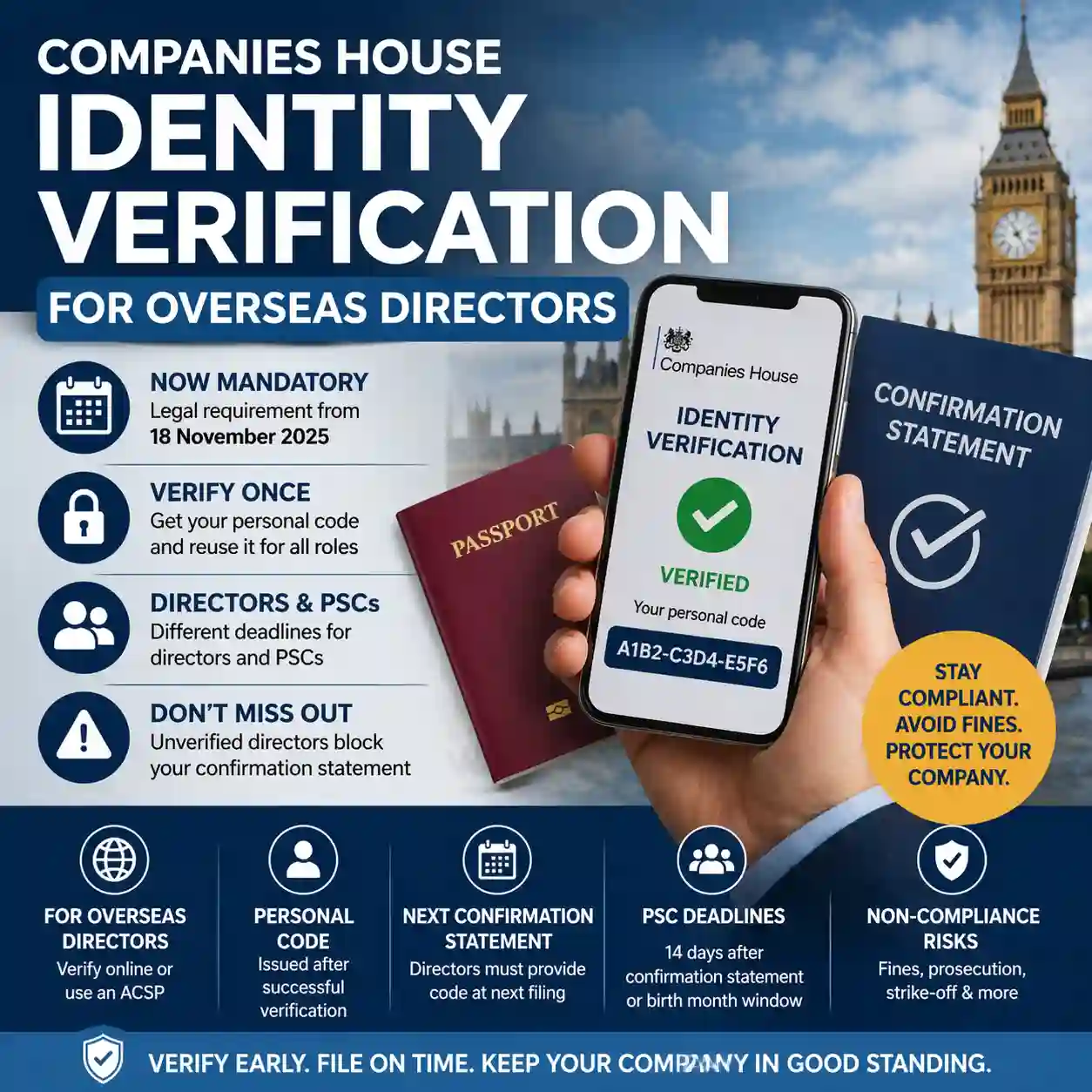
If you live outside the UK but run a UK company, Companies House identity verification is now a legal requirement you cannot ignore. For most overseas directors, the practical trigger is the company’s next confirmation statement, because Companies House will not accept that filing until all directors have verified their identity and the required personal codes are provided correctly.
What Companies House identity verification actually is
Identity verification is the new legal process for proving that a person setting up, running, owning or controlling a company is who they claim to be. In practice, it affects directors, people with significant control, and some overseas-company directors with a UK establishment. In most cases, a person only needs to verify once. After successful verification, Companies House issues a personal code that is then used to connect the verified identity to the relevant company roles.
| Person | Must verify? | How the role is linked |
|---|---|---|
| Existing director | Yes | Personal code is provided in the next confirmation statement |
| New director appointed from 18 November 2025 | Yes | Personal code is provided in the appointment or incorporation filing |
| Existing PSC | Yes | Personal code is provided through the PSC verification service during the relevant 14-day window |
| Person who is both director and PSC | Yes | Verify once, but provide the code separately for each role |
| Director of an overseas company with a UK establishment | Yes | Separate overseas-company process using form OS VS01 applies |
How overseas directors can verify
There are two main routes. The first is direct verification through GOV.UK One Login. The second is verification through an authorised agent, known as an Authorised Corporate Service Provider, or ACSP. For many overseas directors, the most practical choice depends on the type of ID available and whether a direct online match is likely to work smoothly.
| Route | Best known use case | Key point |
|---|---|---|
| Direct GOV.UK One Login | Director has accepted photo ID and can complete online checks | Commonly easiest with a biometric passport |
| ACSP verification | Director is overseas and wants an accountant or solicitor to handle the verification route | ACSP must be registered with Companies House and AML supervised |
For direct verification, the cleanest route is usually a biometric passport. If the direct route is not practical, an Authorised Corporate Service Provider can verify identity on your behalf. Companies House treats this as a formal authorised-agent route rather than a casual filing service.
Which documents usually work best for overseas directors
The live GOV.UK service accepts a biometric passport from any country for the direct route. For ACSP-led verification, the identity verification standard is broader, but where the person being verified does not live in the UK, at least one government-issued document is required.
| Verification route | Typical strongest document | Practical note |
|---|---|---|
| Direct GOV.UK One Login | Biometric passport from any country | Usually the simplest document for overseas directors |
| Direct GOV.UK One Login | UK photocard driving licence | Only relevant if the director holds one |
| ACSP verification | Passport plus any supporting information the verifier requires | Used where direct matching is difficult or impractical |
| ACSP verification | Other approved government-issued photo ID | Depends on the ACSP’s method and the Companies House standard |
What a Companies House personal code is
Once identity verification is completed, Companies House issues a personal code. The code belongs to the individual, not the company. The same code is reused across multiple companies and roles, although it still has to be provided separately where the role-specific filing rules require it. Directors should keep the code secure, but it can be shared with trusted people filing on their behalf, such as their accountant.
When directors need to act
For most existing directors of UK limited companies, the practical timing point is the company’s next confirmation statement. For new appointments from 18 November 2025 onwards, the personal code must be provided as part of the appointment or incorporation filing.
| Situation | What must happen | Practical timing point |
|---|---|---|
| Existing director of a UK company | Verify identity and provide personal code | At the company’s next confirmation statement |
| New director from 18 November 2025 | Verify identity and provide personal code | On appointment or incorporation |
| Director of several UK companies | Verify once | Provide the same code for each company when required |
| Director of an overseas company with a UK establishment | Verify and complete OS VS01 if required | By the anniversary of the date the UK establishment was opened |
PSC timing is different from director timing
This is where many people get caught out. If you are both a director and a PSC of the same company, you only verify once, but you must provide the same personal code separately for each role. As a director, the code goes into the confirmation statement. As a PSC, the code must be provided through the PSC service.
| PSC situation | Timing rule |
|---|---|
| Director and PSC of the same company | PSC code must be provided within the 14-day period starting the day after the company’s confirmation statement date |
| PSC but not a director of that company | Code must be provided within the first 14 days of the PSC’s birth month |
| New PSC added after 18 November 2025 | Code can be provided when first added to the register, or within 14 days of being added |
Worked examples
| Example | Practical result |
|---|---|
| You are both a director and PSC, and the company’s confirmation statement date is 31 March 2026 | Director code goes into the confirmation statement. PSC code must be dealt with from 1 April to 14 April 2026 |
| You are a PSC only, and your birth month is July | Your PSC code must be provided in the first 14 days of July |
| You become a new PSC on 10 June 2026 | You can provide the code when added to the register, or within 14 days of being added |
What happens if you cannot file because a director is not verified
This is the issue most UK companies with overseas directors will actually feel first. Companies House will not accept a company’s confirmation statement until all current directors have verified their identity. If one director has not verified, or has verified but cannot connect their personal code because of a record mismatch, the whole company can be blocked from filing.
Because every company must still file a confirmation statement at least once every 12 months and within 14 days after the end of the review period, a blocked filing can quickly become a wider compliance problem. That is why it makes sense to keep identity verification inside your wider filing deadlines calendar and broader maintaining good standing process.
| Problem | Immediate effect | Typical fix |
|---|---|---|
| One director has not verified | Confirmation statement blocked | Verify that director first |
| Director verified, but code will not connect | Confirmation statement still blocked | Check code entry and Companies House personal details |
| Person is both director and PSC, but only the director step was completed | PSC role remains incomplete | Provide the code again through the PSC service |
| Overseas director cannot use the direct route smoothly | Risk of filing delay | Arrange ACSP verification early |
| Former director still appears on the register | Current filing position may be blocked or incorrect | Update director records before filing |
Common problems overseas directors run into
- Date-of-birth or record mismatches. If Companies House records do not match the verified details, the code may not link correctly.
- Assuming one role filing covers both director and PSC status. It does not. The code must be provided separately for each role where the rules require it.
- Waiting until the confirmation statement deadline. That leaves no time to fix document, code or record issues.
- Using an agent without checking they are a registered ACSP. Only properly authorised agents can carry out Companies House verification for clients.
- Treating non-compliance as a minor admin issue. Companies House has published enforcement routes including financial penalties, prosecution, register annotations and referrals.
What if you miss the deadline?
Once the due date passes, the issue becomes legal as well as procedural. Companies House has stated that it is unlawful for a director to continue acting without completing identity verification, and the company may also be in breach if one of its directors is unverified. For confirmation statements, Companies House may issue a financial penalty and the company may be struck off if the filing is missed.
Companies House has also published an enforcement approach that includes prosecution through court, referral to the Insolvency Service, financial penalties, register annotations, director disqualification and court orders in appropriate cases.
Is there any relief if you genuinely cannot comply on time?
Relief exists, but it is limited and should not be treated as an ordinary planning tool. For PSCs, Companies House provides a route to request a 14-day extension if the request is made before the deadline passes. There is also a representation route for certain identity-verification default-letter cases, but that is not a substitute for actually verifying. It is only a way to ask Companies House to pause enforcement in limited circumstances.
Practical step-by-step plan for overseas directors
- Check every current director and PSC role shown on the Companies House register.
- Verify each individual as early as possible rather than waiting for the filing date.
- Make sure each person stores their Companies House personal code securely.
- If someone is both a director and a PSC, plan for both role-linking steps.
- If the direct route is likely to be difficult, arrange ACSP verification early.
- Check for mismatched dates of birth or stale Companies House records before the confirmation statement is due.
- Update director, PSC, registered office and registered email changes before filing the confirmation statement.
- File the confirmation statement only once every current director’s code is ready and correctly linked.
This process also fits naturally with registered office address, company secretary, international services and non-UK resident tax advice support where overseas ownership creates wider admin and compliance pressure.
When to get professional help quickly
Professional support is often worth considering where there are several overseas directors, one person holds both director and PSC roles across multiple companies, the company is close to its confirmation-statement deadline, an ACSP route is needed, or the Companies House register contains old or inconsistent personal data. It is also sensible where broader filings are at risk, because an identity-verification issue can spill into annual accounts filing and wider compliance work very quickly.
FAQs: Companies House Identity Verification for Overseas Directors
Yes. Directors of UK companies must verify their identity, including directors who live outside the UK.
Yes, if the passport is biometric. A biometric passport from any country can be used in the direct online route.
No. In most cases you verify once and reuse the same personal code for each role you hold, although it still needs to be provided where the relevant filing rules require it.
No. You verify once, but you must provide the same personal code separately for the director role and the PSC role.
No. Companies House will not accept the confirmation statement until all current directors have verified their identity.
Common causes include entering the code incorrectly, having an incorrect date of birth on Companies House records, or incorrect details having been supplied by an ACSP.
Sometimes. Companies House provides a route to request a 14-day extension, but the request must be made before the deadline passes.
Yes. Overseas companies use a separate process and, where applicable, form OS VS01.
Related Guides
Latest Posts


Speak to a UK Accounting Expert Today
From bookkeeping and payroll to management accounts and financial forecasting, Accusolve Accountants helps UK and overseas businesses stay compliant with HMRC and grow with confidence. Get tailored advice from our friendly team.
Get a Free Consultation
Fast response • Fixed-fee quotes