Annual Accounts Filing for Overseas Directors
Annual Accounts
Published: 3/6/2026
If you are a non-UK resident running a UK limited company, annual accounts filing still applies in full, and overseas directors need to understand what records are required, which UK reporting framework may apply, when Companies House deadlines fall, and which common mistakes can trigger penalties, delays, or unnecessary amendments.
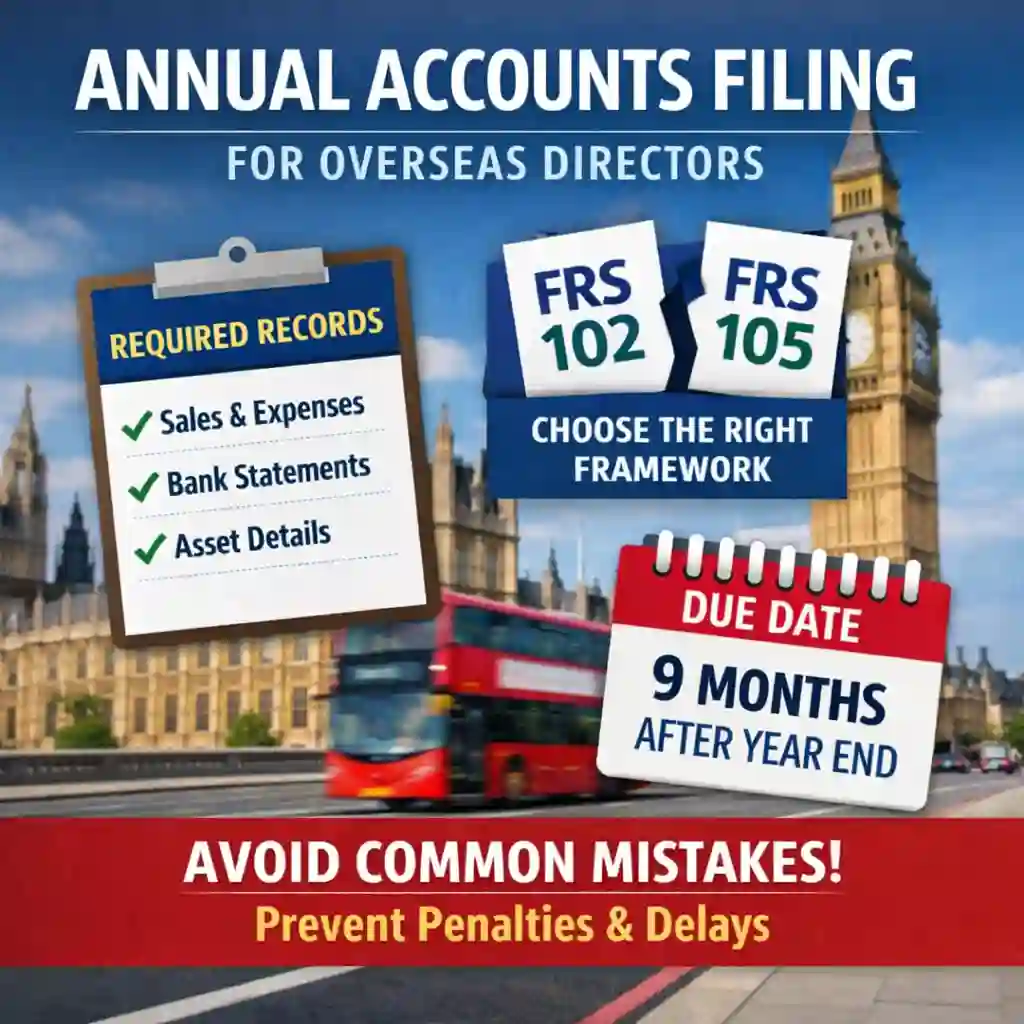
For overseas directors, annual accounts filing UK is not optional simply because you live outside the UK. If your company is incorporated in the UK, you are still responsible for maintaining proper accounting records, preparing statutory accounts, and filing them with Companies House on time. In practice, that means you should treat year-end compliance as part of a wider process that also includes UK annual accounts compliance, accurate bookkeeping, and tax reporting support where needed.
What overseas directors need before filing
Before statutory accounts can be prepared properly, your company should have complete and well-organised financial records. This normally includes sales and purchase records, bank statements, payroll data, VAT workings where relevant, fixed asset information, loan agreements, and prior-year accounts. Where the company trades internationally, it is also important to keep a clear trail for foreign currency transactions, overseas invoices, payment platform settlements, and director expenses incurred outside the UK.
- Complete bookkeeping records for the financial year, including bank, sales, purchase, and expense data.
- Year-end balance sheet support such as debtor, creditor, loan, and fixed asset schedules.
- Clarity on whether the company is likely to report under FRS 102 or FRS 105.
- Enough time before the deadline to prepare, review, and submit accounts without last-minute filing risk.
Key year-end records checklist
| Area | What you should have ready | Why it matters |
|---|---|---|
| Core bookkeeping | Sales invoices, purchase invoices, bank statements, card statements, payment processor reports | Forms the foundation of the profit and loss account and balance sheet |
| Balance sheet support | Debtor and creditor listings, director’s loan account, loan agreements, HP agreements | Helps support figures filed in the statutory accounts |
| Fixed assets | Asset register, additions, disposals, depreciation workings | Needed to prepare accurate year-end asset values |
| Payroll | PAYE summaries, payroll journals, pension data, benefits details where relevant | Ensures wages and liabilities are correctly reflected |
| VAT | VAT returns, workings, reconciliations, corrections where applicable | Helps align VAT records with the accounts |
| International activity | Foreign currency transactions, overseas invoices, transfer evidence, exchange calculations | Important for overseas directors managing cross-border operations |
| Prior-year documents | Last filed accounts, prior corporation tax data, confirmation statement dates | Reduces carry-forward errors and deadline confusion |
FRS 102 vs FRS 105: which framework may apply?
One of the most important technical questions for overseas directors is which accounting framework the company should use. For many UK companies, the relevant framework is FRS 102. Smaller qualifying entities may use the small companies regime within FRS 102, while micro-entities that qualify may be able to use FRS 105. Getting this wrong at the start can lead to unnecessary rework, missing disclosures, or confusion over what needs to be filed.
| Framework | Usually relevant for | What overseas directors should know |
|---|---|---|
| FRS 102 | Many UK companies not using IFRS, FRS 101, or FRS 105 | Common UK GAAP framework for statutory accounts |
| FRS 102 Section 1A | Small entities that qualify for the small companies regime | Uses FRS 102 recognition and measurement with reduced small-entity presentation and disclosure rules |
| FRS 105 | Micro-entities that qualify for the micro-entities regime | Simplified framework for eligible very small companies |
Where the company has overseas transactions, multiple income streams, or more complex balance sheet items, it is especially important to confirm the correct framework early in the process. This is often best handled alongside year-end accounts preparation rather than at the final filing stage.
When annual accounts are due
For most private limited companies, annual accounts are due at Companies House 9 months after the accounting reference date. This deadline is separate from the due date for Corporation Tax payment and separate again from the deadline for the Company Tax Return. Overseas directors often assume these are all one deadline, but they are not, and mixing them up is a common cause of late filings.
| Period end | Companies House accounts deadline | Corporation Tax payment deadline | Company Tax Return deadline |
|---|---|---|---|
| 31 March 2026 | 31 December 2026 | 1 January 2027 | 31 March 2027 |
| 30 June 2026 | 31 March 2027 | 1 April 2027 | 30 June 2027 |
| 30 September 2026 | 30 June 2027 | 1 July 2027 | 30 September 2027 |
| 31 December 2026 | 30 September 2027 | 1 October 2027 | 31 December 2027 |
| 4 April 2026 | 4 January 2027 | 5 January 2027 | 4 April 2027 |
For first accounts, shortened accounting periods, or companies that have changed their accounting reference date, the exact deadline may differ. This is why many overseas directors benefit from maintaining a clear filing deadlines calendar and linking it to their accounts and tax timetable.
Common mistakes overseas directors make
The biggest problems usually come from timing, poor records, or misunderstanding which UK filings are required. The most common mistakes include:
- Confusing Companies House accounts with HMRC filings and assuming one submission covers everything.
- Leaving bookkeeping until year end, which makes the accounts slower, more expensive, and more error-prone.
- Using the wrong reporting framework, especially where the company may qualify as small or micro.
- Assuming dormant means nothing needs to be filed, when dormant companies still have filing duties.
- Submitting too close to the deadline, leaving no time to correct rejections or missing information.
- Changing the year end without understanding the filing effect, which can create new deadline pressures.
- Not coordinating accounts with the tax position, particularly where cross-border activity or overseas expenses are involved.
A better approach is to combine routine bookkeeping, year-end review, and CT600 tax return planning into one structured process rather than trying to assemble everything at the last moment.
Best-practice process for overseas directors
In most cases, the safest route is to keep bookkeeping current throughout the year, reconcile key balance sheet areas monthly, confirm the reporting framework early, prepare the statutory accounts well before the deadline, and then align the final numbers with tax filings and payment obligations. Overseas directors should also make sure their wider UK compliance responsibilities are not overlooked, including the confirmation statement and any support needed under international services.
Where records are incomplete, cross-border transactions are material, or the company has been inactive for part of the year, professional review can reduce the risk of late filing penalties and help ensure the accounts are prepared on a proper and supportable basis.
Official reference sources
FAQs: Annual Accounts Filing for Overseas Directors
No. If the company is incorporated in the UK, the normal Companies House filing rules still apply, regardless of where the director lives. Overseas residence does not remove the company’s filing obligations.
For most private limited companies, annual accounts are due 9 months after the accounting reference date. This is separate from Corporation Tax payment and separate from the Company Tax Return deadline.
FRS 102 is a common UK GAAP framework used by many companies. FRS 105 is designed for qualifying micro-entities and is more simplified. The correct framework depends on the company’s size and eligibility.
Yes. A dormant company may still have annual filing obligations, so directors should not assume that inactivity means there is nothing to submit.
At a minimum, directors should keep sales and purchase records, bank statements, expense evidence, payroll records where relevant, asset details, tax records, and any overseas transaction support such as foreign currency workings and international invoices.
One of the most common mistakes is treating Companies House accounts, Corporation Tax payment, and the Company Tax Return as if they are one single deadline. They are separate obligations and should be managed separately.
In some cases, yes, but a year-end change can alter filing deadlines and should be handled carefully. It is best reviewed before accounts become overdue and before related tax deadlines are affected.
No. This article is general information only and should not be treated as legal, tax, or accounting advice for a specific company or director. Professional advice should be taken on your exact circumstances.
Related Guides
Latest Posts



Speak to a UK Accounting Expert Today
From bookkeeping and payroll to management accounts and financial forecasting, Accusolve Accountants helps UK and overseas businesses stay compliant with HMRC and grow with confidence. Get tailored advice from our friendly team.
Get a Free Consultation
Fast response • Fixed-fee quotes