Monthly Bookkeeping vs Year-End Rush
Bookkeeping
Published: 2/15/2026
Most UK SME owners don’t choose the year-end rush — it happens when bookkeeping gets delayed. The problem is that ‘later’ is the most expensive time to do it. This guide shows the real time/cost trade-offs and the hidden messy books tax that hits many limited companies.
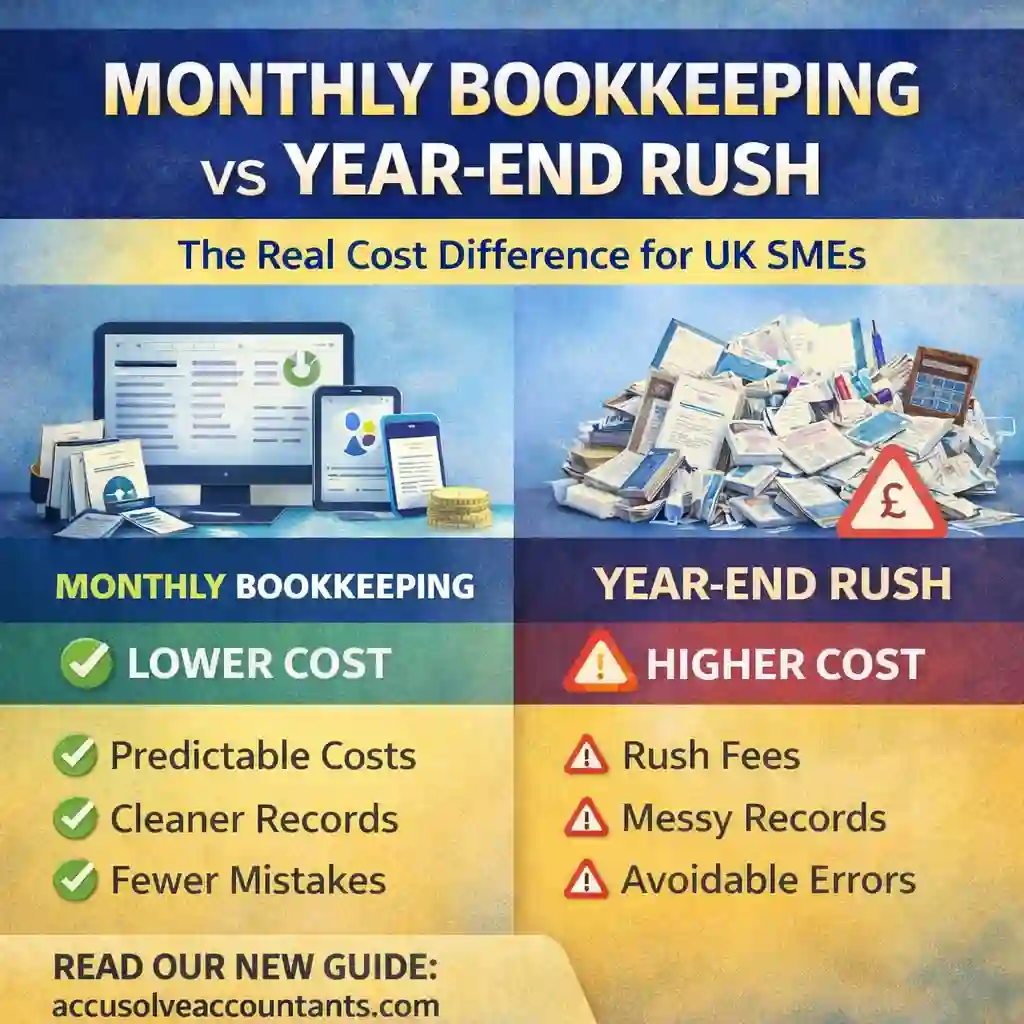
Most UK SME owners don’t choose the year-end rush — it happens when bookkeeping becomes “something we’ll sort later”. The problem is that “later” is the most expensive time to do it.
This guide breaks down the time + cost trade-offs, explains the hidden “messy books tax” you pay when records aren’t kept up to date, and gives you a simple framework to decide which approach makes sense for your business. If you want hands-on help, explore our bookkeeping services or accounting services.
Bottom line: Delaying bookkeeping rarely saves money — it usually shifts costs into clean-up work, urgent turnaround fees,
and avoidable errors (VAT, payroll, director/personal spend).
What “monthly bookkeeping” actually means (in plain English)
Monthly bookkeeping isn’t about perfection. It’s about keeping your records current enough that:
- your bank is reconciled
- your income/expenses are categorised consistently
- VAT/PAYE (if applicable) aren’t a surprise
- your year-end accounts become an admin task, not a rescue mission
A normal monthly cycle is: collect invoices/receipts → reconcile bank feeds → review uncategorised items → run a basic P&L check → fix issues while they’re still fresh. Using the right tools helps: see our accounting software setup (including Xero and QuickBooks workflows if relevant).
What the “year-end rush” looks like (and why it costs more)
Year-end rush bookkeeping usually means doing 12 months of work in a few days/weeks, when:
- bank transactions are uncategorised
- receipts are missing
- director’s loan and personal spend is mixed in
- payments don’t match invoices
- VAT returns were estimated or done without clean records
- the person doing the work has no context (because it’s months old)
And because the filing timetable is fixed, you lose negotiating power: you pay more to get it done fast. If you’re already close to a deadline, our annual accounts filing and company compliance support can help you recover quickly.
The real cost difference: a practical comparison
Here’s a realistic comparison for a typical UK SME limited company where the owner wants accounts done properly and on time.
1) Time cost (hours you’ll spend)
| Task | Monthly bookkeeping approach | Year-end rush approach |
|---|---|---|
| Transaction coding + queries | 15–45 mins per week | 10–30 hours in one hit |
| Finding/confirming receipts | Ongoing, easy | Painful, time-consuming |
| Reconciliation & error fixing | Monthly, small fixes | Big fixes + rework |
| Year-end handover to accountant | Simple pack | “Detective work” |
The key difference isn’t only hours — it’s the quality of hours. Monthly bookkeeping uses short, low-stress sessions. Year-end rush eats evenings/weekends and forces decisions without good data.
2) Money cost (what you actually pay)
Accountants/bookkeepers generally price based on transaction volume, complexity (VAT, payroll, multi-currency, e-commerce), how clean the records are, and how urgent the deadline is.
| Cost driver | Monthly bookkeeping | Year-end rush |
|---|---|---|
| Bookkeeping effort | Predictable | High + unpredictable |
| Accountant time | Review-focused | Rebuild + review |
| Urgency premium | Low | Often high |
| Error/penalty risk | Lower | Higher |
The “Messy Books Tax”: the hidden cost most SMEs don’t measure
The “messy books tax” is the extra cost you pay because your records aren’t clean when they need to be. It’s not a formal tax — it’s the real-world cost of clean-up, rework, missed claims, and avoidable problems.
Messy books tax shows up as
- Extra billable hours to reconstruct records
- Missed deductions (you don’t claim what you can’t evidence)
- VAT mistakes that take time to correct (see VAT returns)
- Director/personal spend confusion (often a director’s loan issue)
- Cashflow blind spots (numbers aren’t reliable until it’s too late — see cash flow forecasting)
- Opportunity cost (delayed decisions on pricing, hiring, investment)
A simple way to estimate your messy books tax
Ask yourself: how many hours did you spend last year finding receipts, explaining transactions, or fixing issues? Multiply that by your realistic hourly value. Even 10 hours of owner time at £50/hour is £500 — before you pay anyone to clean it up.
Why monthly bookkeeping usually wins (even for tiny businesses)
Monthly bookkeeping tends to win because it reduces clean-up time, reduces stress, and makes VAT/PAYE easier (where applicable). It also supports better decisions because your numbers are current.
If you have payroll, clean bookkeeping helps your payroll services run smoothly. If you’re a sole trader as well as a company director, keeping records tidy helps your Self Assessment too.
When a “year-end only” approach can still work
There are a few cases where year-end-only bookkeeping can be acceptable:
- Very low transaction volume (a few invoices a month)
- No VAT, no payroll, no complex expenses
- Business bank account is clean and separate
- The owner keeps strong records and receipts throughout the year
Even then, a light-touch quarterly review often prevents problems. Many SMEs choose a hybrid model using outsourced accounting so they’re not rebuilding the year at the last minute.
A simple hybrid that works for many UK SMEs
If monthly feels like “too much”, do this instead:
Weekly (10 minutes)
- Upload receipts
- Tag anything unclear
Monthly (30–60 minutes)
- Reconcile bank
- Clear uncategorised
- Check director/personal items are coded correctly
Quarterly (60–90 minutes)
- Review profit + rough tax estimate
- Tidy VAT/PAYE items (if applicable)
- Check debtors/creditors list
Month-end checklist (copy/paste)
- Bank account reconciled to month end
- Sales invoices raised and matched to payments
- Supplier bills recorded (or marked as missing)
- Receipt capture complete (fuel, travel, subscriptions, equipment)
- Director/personal transactions coded correctly
- VAT control checked (if VAT registered)
- Payroll journals posted (if running payroll)
- Profit & loss reviewed for anomalies
- Large one-off items noted (equipment, refunds, unusual costs)
FAQs: Monthly bookkeeping vs year-end rush
Often, yes — because your accountant spends less time rebuilding and more time reviewing and finalising.
It also reduces urgent “rush” work near deadlines.
Missing context. After 6–12 months, nobody remembers what transactions were for, and receipts are harder to find — which creates rework and delays.
Usually, yes. VAT errors are more likely when records aren’t kept tidy, and corrections often cost more than doing it right monthly.
Keep the business bank account clean, separate personal spend, capture receipts as you go, and use consistent categories.
Good software setup and bank feeds help.
It’s when personal transactions are mixed into business accounts and not tracked properly, which can create tax and reporting complications.
Monthly coding and reconciliation reduces this risk massively.
Start with a monthly bank reconciliation habit. Even if categorisation isn’t perfect at first, reconciliation prevents the biggest clean-up problems.
Related Services
Latest Posts


Speak to a UK Accounting Expert Today
From bookkeeping and payroll to management accounts and financial forecasting, Accusolve Accountants helps UK and overseas businesses stay compliant with HMRC and grow with confidence. Get tailored advice from our friendly team.
Get a Free Consultation
Fast response • Fixed-fee quotes